House Music Has Become the Beige Furniture of Nightlife
House music has quietly become the default language of nightlife and it’s making every room feel the same.
- By: Julianne Elise Beffa
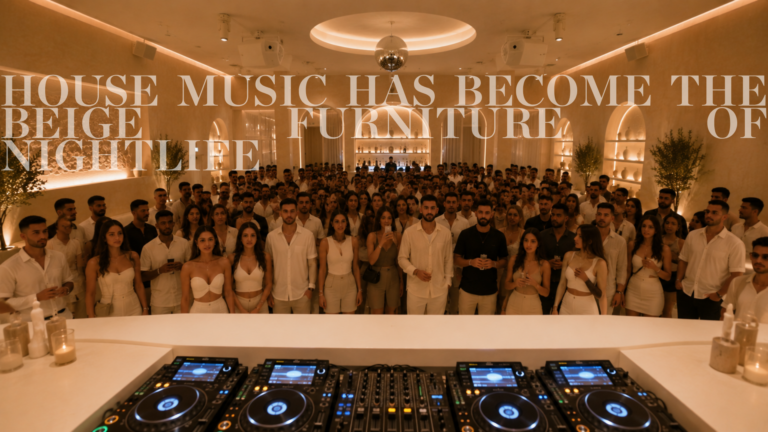
Everywhere I go, nightlife sounds the same. Deep bass, robotic builds that feel emotionally unavailable, and crowds either frozen in curated coolness or moving like they’re auditioning for a very restrained episode of Jersey Shore. House music has become the beige furniture of nightlife.
While this comparison might seem random, it isn’t accidental. Beige furniture had its own cultural takeover moment around 2018, when Kanye West and Axel Vervoordt famously designed the Kardashian-West home in a muted, monochrome palette of beige, stone, and carefully engineered emptiness. From there, the “clean girl” aesthetic took over everything- suddenly every apartment, every Instagram feed, every aspirational interior started to converge on the same beige cloud sofa, the same washed-out minimalism, the same idea that neutrality = taste.
House music has followed a similarly exhausting trajectory in nightlife: what started as a specific subculture with its own history, geography, and emotional texture has steadily expanded into a default setting, defining the sound of almost every club, rooftop, restaurant, lounge, and nightlife experience in the same homogenized way. Once rooted in underground rave culture and tightly knit microcommunities, it has now moved from niche to unavoidable, bleeding into every corner of nightlife.
No matter what space you walk into in New York, Miami, LA or even the Hamptons, you are hearing variations of the same set. The same endless, mindnumbing loop of house, tech house, and melodic techno that has quietly become the default identity of modern nightlife. House music isn’t a niche genre choice anymore, it’s a pre-installed atmosphere that’s exhausting- and not in a good way.
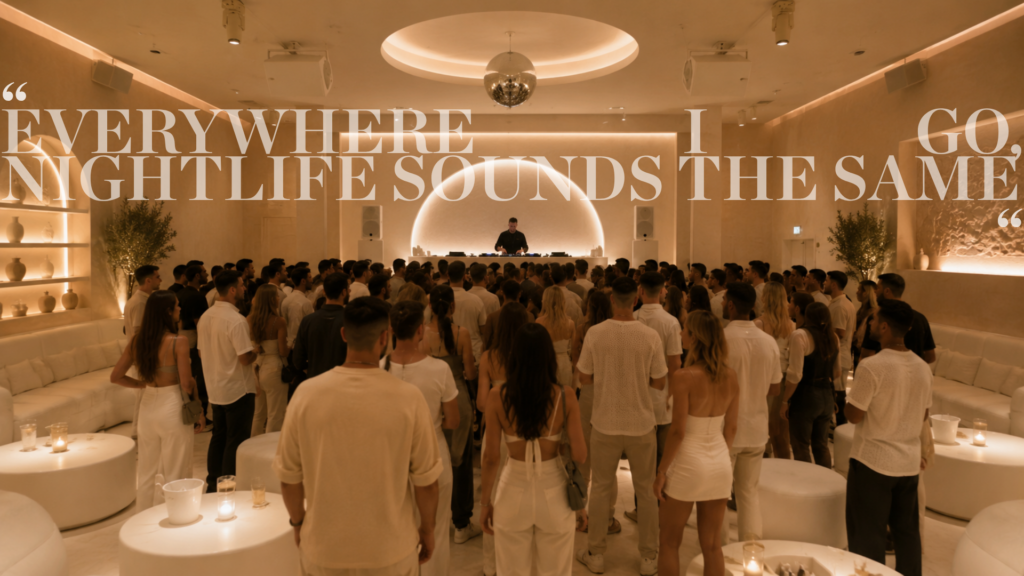
This past Wednesday night at Le Bain, my friends and I went into the weekly night expecting Afrobeats, which is what the night has been marketed as for years. We encountered one of the rudest doormen I’ve seen in recent years, which should have foreshadowed the rest of the night. Nevertheless, we wanted to feel alive and listen to lyric-driven music from Tyla, Tems and Burna Boy that would match the energy of a crowd that actually wants to dance with each other. Instead, we walked into a foggy club so heavy on deep techno and minimal transitions that it felt less like a party and more like beige wallpaper being applied over a room that used to have personality. Nothing built. Nothing shifted. There was no moment where the room collectively locked into something recognizable. It just continued, almost mechanically, as if the point was endurance, or in my case, annoyance, rather than enjoyment. That experience is sadly not an outlier anymore- it’s a pattern.
Last weekend, I was at a rooftop World Cup party anticipating what anyone would reasonably expect in that setting: global hits, Euro-pop, throwbacks, songs that feel like equal parts communal and celebratory. Instead, the soundtrack was a rotation of Rüfüs Du Sol edits and John Summit-style remixes that did not feel designed for celebration so much as aesthetic cohesion. Everyone tried desperately to look like they were having a good time, but if you actually paid attention, very few people were responding to the music itself. They were responding to the idea of being in a cool room where music was happening. That distinction matters more than people want to admit.
Somewhere along the way, nightlife stopped being about recognition and started being about atmosphere management. The goal is no longer to make a room erupt. It is to maintain a consistent vibe that signals taste, restraint, and cultural awareness, similar to beige furniture in every home. House music, especially in its more commercial and tech-driven forms, fits that perfectly. It is safe, globally legible, and it rarely disrupts the visual or social aesthetic of a venue. But in becoming the safest option, it has also become the most emotionally neutral and, quite frankly, painfully boring one.
The goal is no longer to make a room erupt. It is to maintain a consistent vibe that signals taste, restraint, and cultural awareness, similar to beige furniture in every home.
I write this as a nightlife editor who is out at least five nights a week, moving between industry events, restaurant openings, rooftop parties, nightclub programming, and brand events across New York. I go to roughly 20 events a week, and I honestly can’t remember the last time I walked into one and wasn’t greeted with the exact same beat (though there is one exception, which I’ll get into later). Whether I’m out celebrating a tequila launch, a venue anniversary, a new cocktail bar, or a seven-figure fashion or beauty brand activation, the soundtrack rarely changes.
I keep finding myself coming back to the same question: how is anyone supposed to differentiate an experience when five different events in a single night all sound identical? And more importantly- after a recent experience- why the hell is a tequila brand playing Peggy Gou instead of Bad Bunny or Peso Pluma?
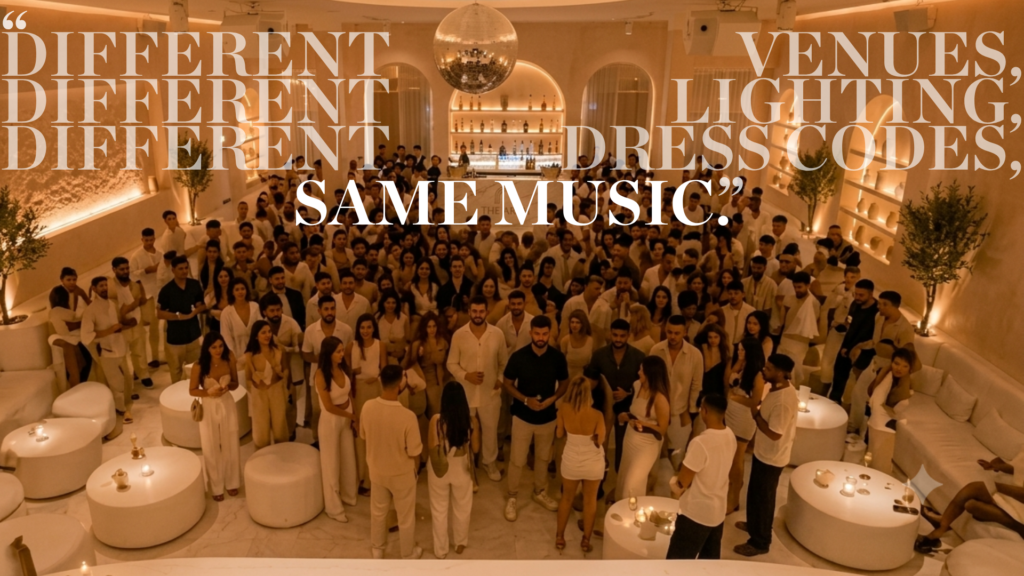
The repetition is impossible for me to ignore anymore. Different venues, different lighting, different dress codes, same music. Build, loop, filtered drop that never fully resolves, repeat. It is not that house music is the problem. It is that its dominance has created a kind of monoculture where anything that interrupts the mood is quietly filtered out. What has been lost in that process is not sophistication- we lost friction.
And nightlife used to rely on friction. On moments of recognition where a room hears a song and immediately reacts together because it shares cultural memory. Lyrics mattered because they created instant alignment. A chorus could collapse distance between strangers. A throwback could trigger an era of nostalgia and change the temperature of a room in seconds. That kind of reaction-based energy is increasingly rare in spaces that now prioritize continuity over disruption.
Even hip-hop and pop, which nightlife once reflected in real time, feel oddly disconnected from what is happening on dance floors. Drake released three record-breaking albums that dominate streaming platforms and cultural conversation, Kehlani continuously puts out music built for late-night emotional release, Bad Bunny is still the #1 artist in the world and throwback tracks still reliably go viral in every other context. Yet inside many clubs and rooftop venues, those records either never appear or only surface once they have been stripped into house remixes that remove the very elements that made them recognizable and top-charting in the first place.
It creates a strange contradiction. The most culturally dominant music in the world is often absent from the spaces that are supposedly designed for collective celebration of culture. This is where the shift becomes more than just aesthetic- it becomes behavioral.
The most culturally dominant music in the world is often absent from the spaces that are supposedly designed for collective celebration of culture.
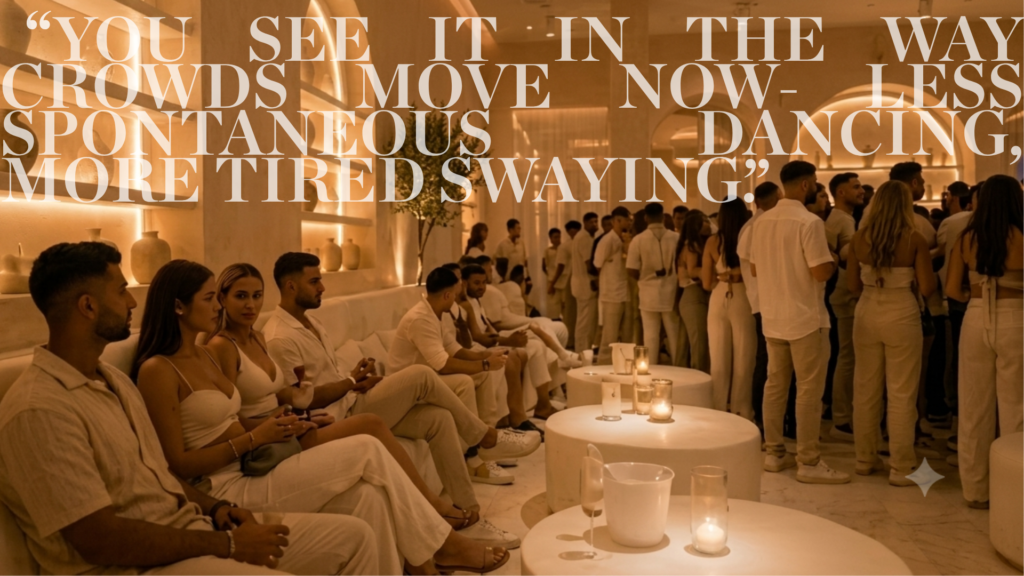
When music loses its recognizability, people stop reacting to it and start performing around it. You see it in the way crowds move now- less spontaneous dancing, more tired swaying. Less release, more positioning. It’s not that people stopped going out, as social media loves to suggest. It is that they are no longer being given moments that demand a real response. I have been thinking about that shift a lot, especially after seeing fellow party girl Alix Earle say in a recent TikTok that she is tired of hearing house music everywhere while in the Hamptons and just wants a night where she can scream lyrics with her friends again. Felt.
It is easy to dismiss this article as a complaint by a writer who detests house music, but this story actually points to something more structural. People are not asking for less musical sophistication, they are asking for shared emotional access. Because that is what lyrics do that house music does not: they create entry points and memories. They create moments where strangers become synchronized without needing to be curated into it.
For example, on Juneteenth, my bestie and I went to Brooklyn and ended up at the Good Vibrations at Brooklyn Roots Collective party. We arrived early- almost too early, since we were the first ones there- and started dancing in an empty room, not because it was performative, but because there was nothing else to do but commit to the moment. It was genuinely the first time I walked into a space and heard throwback hip-hop and R&B music in months and the moment had to be seized. As people slowly filled in, the energy didn’t come from a drop or a dramatic transition. It came from recognition. We were all immediately dancing to the music because we could actually find our voices inside of it. That night felt like a reminder of what nightlife used to do more consistently: it didn’t just create environments, it created shared experiences.
And that is where the tension sits now. Because modern nightlife has become extremely good at building aesthetically-pleasing environments. The lighting is sharp, the design is stunning, the branding is potent, the bottle service model is more prominent than ever. But in that same process, it has become less reliable at producing moments that people actually remember. House music did not necessarily ruin nightlife. But its overuse in commercial nightlife has created a kind of musical uniformity that prioritizes aesthetic safety over emotional impact.
The result is a generation of beautifully designed rooms filled with people who are technically in the same place, but no longer having the same experience. Which raises the question no one in nightlife seems eager to answer out loud: if nothing excites the room anymore, what exactly are we going out for?
Read More


Exclusives
Julianne Beffa