Nightlife Isn’t Dead. It’s Just Boring Now.
Men in the club, $27 cocktails and phones filming every move are making nightlife feel less spontaneous, more expensive and a lot less fun. Here’s why.
- By: Julianne Elise Beffa
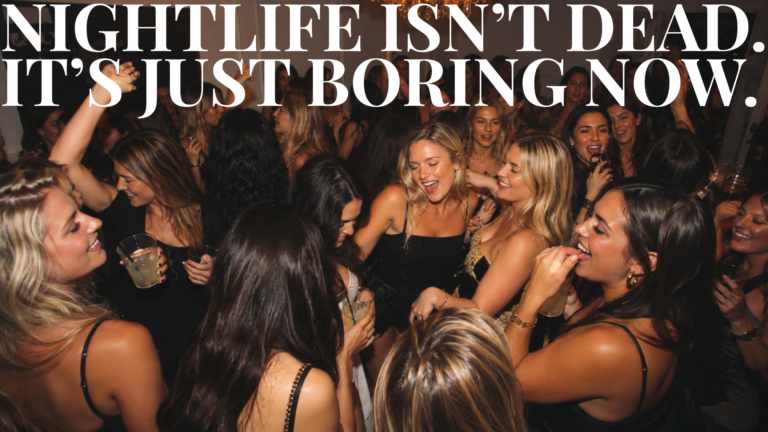
Earlier today, I was chatting with a fellow editor about our most memorable nights out, and within minutes we were going bar for bar with our pre-COVID stories: unbuttoning men’s shirts on the dance floor, puking in the bathroom and somehow deciding that was not a good enough reason to go home, bouncing from dinner to the club to another club to another club to afters, then waking up on someone’s couch with a piece of pepperoni stuck to our cheek. Ke$ha once sang about waking up and brushing her teeth with a bottle of Jack Daniel’s and, honestly, same. I could write an entire book about going out, from all the times I was convinced I had met the love of my life on a dance floor to the nights that started with dinner and somehow ended with breakfast, but some of my favorite memories are simply the nights when I left the house with $20 and came home with a story that was worth significantly more than that.
I am, by all accounts, a party girl, and I have spent years putting that title to work in New York, Los Angeles, Miami, Paris, Barcelona, Cannes, Mexico and plenty of cities in between. I have been in enough clubs, bars, restaurants, beach parties, hotel lobbies, after-hours spots and questionable late-night establishments to know that nightlife looks very different depending on where you are, but the best cities tend to have one thing in common: they make it easy to have a night you didn’t plan on having. You can start with one drink and end up somewhere completely different, meet somebody at the bar, run into a friend you haven’t seen in months or follow a group of strangers to an afterparty because, for whatever reason, they seem to know where the night is going. That sense of possibility is what makes nightlife exciting, and increasingly, it is what feels like it is disappearing.
That is why I don’t think nightlife is dead. I honestly think it just got boring.
Before the industry starts blaming Gen Z, declining alcohol consumption or the economy, let’s acknowledge that nightlife is actually doing quite well by many traditional measurements. Clubs are packed, restaurants are full, DJs have become global celebrities, hospitality groups are opening increasingly elaborate venues and consumers are still spending significant amounts of money on entertainment. The problem isn’t necessarily whether people are going out; the problem is what happens when they get there.
Somewhere along the way, going out became less about seeing what happens and more about knowing exactly what is going to happen before you even leave the house. You check Instagram to decide where you’re going, get on the guest list, make a reservation, confirm the minimum spend and arrive at a venue where everything from the lighting to the cocktails to the bathroom mirror has been meticulously designed to create an “experience.” Then the cameras come out. Someone films the DJ, someone records the table, someone takes the group photo, someone gets a video of everyone dancing and somebody is already thinking about what the night will look like online. The night has barely started and somehow it has already been packaged for consumption.
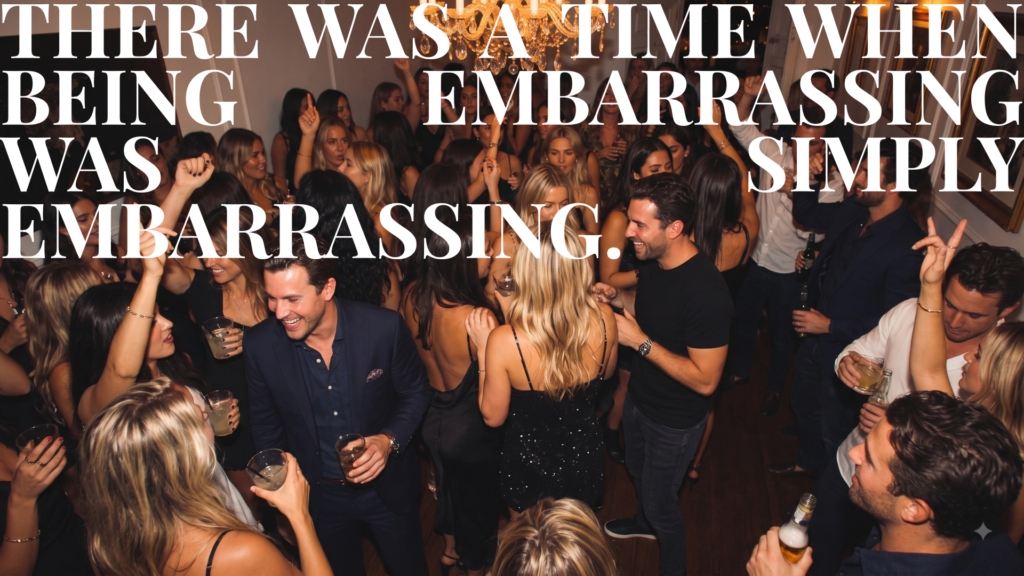
There was a time when being embarrassing was simply embarrassing. You could dance badly, flirt with the wrong person, fall off a barstool or make an objectively terrible decision and, eventually, the story would disappear into the collective memory of your friends. Now there is always the possibility that somebody has captured the moment on a phone and uploaded it before you have even made it home. The dance floor is no longer just a place to dance; it is potentially a content set, and that awareness changes how people behave. We are more conscious of how we look, who we are talking to, how we are dancing and whether that completely unhinged moment is about to become somebody else’s TikTok. We have somehow turned the place where people are supposed to let loose into a place where everyone is hyper-aware of being watched.
And speaking of watching, my TikTok FYP has become a running highlight reel of another increasingly bizarre nightlife phenomenon: men behind the DJ booth, men standing on the booths at tables while the girls are pushed onto the dance floor, and men sitting comfortably at tables while women in heels are standing around them. Somewhere along the way, the social choreography of the club got completely flipped, and I am not sure anyone agreed to the new rules. Even stranger is the sheer lack of actual interaction. Men who once might have approached a woman, bought her a drink or at least attempted to strike up a conversation now seem perfectly content to stand against a wall and stare at women from across the room like they are watching wildlife through binoculars. Meanwhile, the women are dancing, socializing and creating much of the energy that everyone came to experience in the first place. If the girls are creating the party, perhaps nightlife should start acknowledging that reality instead of continuing to build around an outdated idea of what the club is supposed to look like.
I am not pretending I am above any of this. I work in media, spend an absurd amount of time at events and have taken my fair share of photos in beautiful rooms, so I understand why venues want to be visually memorable and why people want to document their nights. The problem starts when the content becomes more important than the experience itself. A beautiful room can certainly get people through the door, but no amount of good lighting can manufacture chemistry between strangers, a great bartender or the feeling that you have accidentally stumbled into the best night of your life.
That is what nightlife has always really sold. The music and cocktails matter, but the product is ultimately social. It is the possibility of meeting someone, discovering a new place, running into an old friend, following a crowd somewhere unexpected or ending up at a diner at 4 a.m. with people whose last names you still don’t know. Those are the stories people tell for years, and they are almost impossible to engineer because their entire appeal is that nobody planned them.
You could dance badly, flirt with the wrong person, fall off a barstool or make an objectively terrible decision and, eventually, the story would disappear into the collective memory of your friends.
They are also becoming increasingly difficult to afford. When a cocktail costs $27, dinner comes with a three-digit check and a night at a popular club requires a reservation, guest list or four-figure minimum, “Let’s just go out” stops being a casual suggestion and starts sounding like a financial commitment. There was a time when you could leave your apartment with $20, meet friends at a bar, order something cheap, wander into another place and somehow end the night with a slice of pizza and a story. Today, a single round can make you question whether spontaneity is worth the charge on your credit card.
That doesn’t mean nightlife needs to go backward. Nostalgia is not a business model, and I am certainly not suggesting that every venue needs to recreate some mythical version of 2012 where everyone drank until sunrise and nobody had a phone. The opportunity for the industry is to understand what people were actually responding to in those nights and build around that feeling rather than trying to replicate the aesthetics of the past.
The next generation of nightlife needs to prioritize social chemistry as much as physical design. That means creating spaces where people can actually talk, move around and interact rather than spending an entire evening standing behind the same table. It means programming that gives people a reason to return beyond the name of the DJ behind the booth, creating different levels of energy throughout a venue and making room for walk-ins, discovery and the possibility that somebody might stumble into a night they never planned on having.
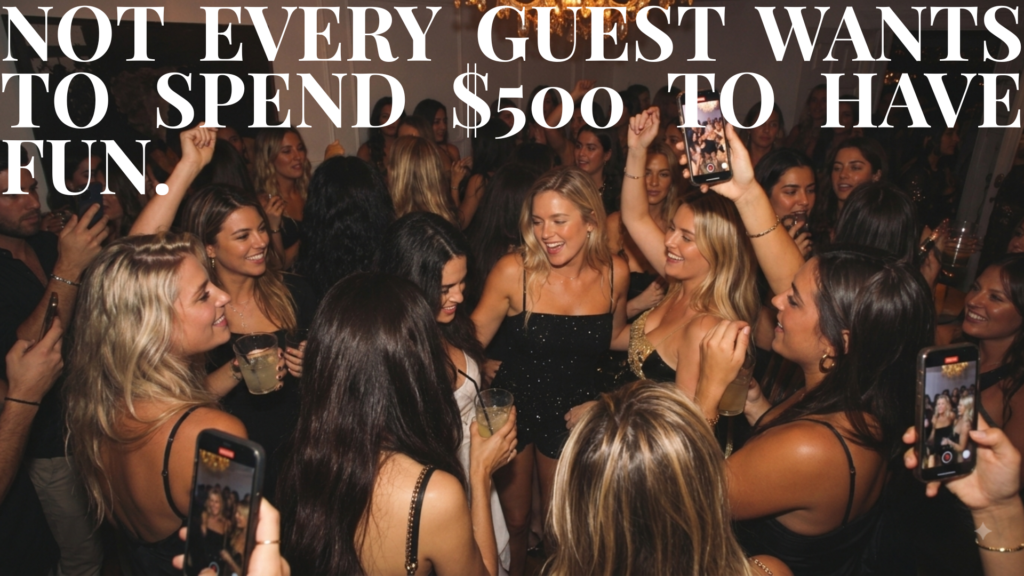
It also means reconsidering the economics of going out. Not every guest wants to spend $500 to have fun, not every group wants a table and not everyone is interested in bottle service. Operators who create compelling experiences at multiple price points have an opportunity to build something far more valuable than a one-night flex: a loyal audience that actually wants to return. A great $15 drink that keeps somebody in the room long enough to order another, meet someone, dance for a while and come back next weekend can ultimately be worth far more than a $30 cocktail sold to someone who never returns.
The same thinking should apply to the industry’s obsession with being “shareable.” The most valuable nightlife experiences are not necessarily the ones that photograph best; they are the ones people tell stories about afterward. A neon sign can generate a post, while a genuinely great bartender can generate a regular. A beautiful bathroom can generate a Reel, while a dance floor where you meet someone who becomes a lifelong friend, partner or terrible ex can generate a memory that survives long after the Instagram Story disappears. One creates content, while the other creates culture, and culture is what nightlife has always sold.
After partying in cities ranging from New York and Los Angeles to Miami, Paris, Barcelona, Cannes and Mexico, I have learned that the cities with the most exciting nightlife aren’t necessarily the ones with the biggest clubs, the most expensive tables or the most elaborate production. They are the places where you can still get lost. They are the cities where one drink can turn into five, where dinner can turn into dancing, where dancing can turn into an afterparty and where somebody you met an hour ago can convince you to go somewhere you’ve never heard of because, somehow, they know that is where everyone is going.
That is the feeling nightlife needs to protect.
The future shouldn’t be about making every night bigger, louder, more expensive or more Instagrammable. It should be about making nightlife feel alive again, which means giving people places where they can talk to strangers, music that makes them want to dance instead of film, bartenders who remember their names, affordable ways to participate and enough room in the experience for the night to change direction. It means giving women room to actually own the dance floor, giving men a reason to participate in the social experience rather than simply spectate from the sidelines, and giving everyone a reason to put the phone away long enough to find out what happens next.
The best nights I have ever had weren’t memorable because the lighting was perfect or because I had the best table in the room. They weren’t memorable because everyone looked incredible in the photos. They were memorable because something happened that nobody planned, and that is precisely what the industry cannot manufacture with a mood board, a celebrity DJ or a $27 cocktail. Maybe that is the next evolution of nightlife: not going backward, not recreating the old days and certainly not pretending that drinking until sunrise is the answer, but creating spaces where the unexpected is still possible. Because nightlife isn’t dead; we have simply gotten very good at taking the unpredictability out of it. Now, the industry has an opportunity to put some of it back.