From Closings to Cocktails: An NYC Agent’s Guide to the Late 20s Single Scene
From Swan Room to Bar Bonobo, this is the exact NYC nightlife itinerary for singles in their late 20s.
- By: Julianne Elise Beffa

There is a distinct shift that happens when you find yourself single in New York in your late 20s, a recalibration that feels less like slowing down and more like finally stepping into a rhythm that actually works. The nights are no longer driven by chaos or obligation, but by intention, instinct, and a sharper understanding of what makes going out feel worth it. For Emma Davis, a luxury real estate agent who has built a following for her hyper-specific nightlife itineraries, this chapter is not about doing less. It is about doing it better.
Her now widely circulated TikTok take on “where to go out when you’re single in your late 20s,” below, resonates because it challenges one of the most persistent misconceptions about nightlife at this age. “People think that going out is going to ruin their next day,” she says. “And then they won’t be able to be productive during critical moments.” In a city that demands constant performance, that fear can quietly dictate how often people allow themselves to go out at all. But her solution is far less dramatic than the problem suggests. “There is obviously a major hack to this. Just don’t drink that much. Or don’t drink at all.”
For Emma, moderation is not a restriction but a system. “I only usually have a max of two drinks,” she explains, noting that her work schedule leaves little room for recovery days. What replaces excess is something more sustainable and, ultimately, more effective. “I’ve learned how to let social energy carry me through the night,” she says. “Game changer.” The result is a version of nightlife that feels additive rather than draining, one that fits into a larger life instead of disrupting it.
Related | Y.E.S: Yap, Eat, and Sip at Skylark NYC
@slimmmmydee So I love going out, sue me! #nycbars #nycnightlife #nycrecs #nycrestaurants #nycclubs ♬ original sound – Slimmmmydee
That same sense of refinement shapes how she approaches the structure of a night out. If early 20s nightlife is defined by large groups and fixed plans, late 20s nights are far more fluid. “Meeting people is way easier than your late 20s than in your early-mid 20s,” she says. “This is around the time where everyone starts to split off into different life stages,” creating space for new connections rather than reinforcing the same social circles. Her advice is simple but strategic. “I suggest going out in small groups of three to four or just with one other person,” she says. “It’s much more likely you’ll get approached by others and you also have more agility to move around.”
One recent night out, entirely unplanned, became a perfect case study in how this approach plays out in real time. What began as an attempt to go to Balthazar quickly pivoted when the bar was booked for a private event. Instead of forcing the night into a rigid plan, Emma and her friend let instinct take over, building an itinerary on the fly that moved seamlessly between moods, neighborhoods, and energy levels.
Meeting people is way easier than your late 20s than in your early-mid 20s
The Itinerary, Exactly How to Do It
- Start social and low-commitment at Corner Bar
“I always make friends here,” Emma says. This is where the night begins to open up. Arrive early, grab a drink, and lean into the standing, social atmosphere. It is the ideal first stop because it requires nothing from you except showing up. - Shift into something elevated at Swan Room
“This is such a grand bar,” she says, describing the high ceilings and cinematic interiors. Order food, settle in, and let the space do the work. “This really isn’t a place for socializing,” she adds, “but great for a date or impressing out-of-towners.” - Pick up the energy at Crane Club
By this point, the night calls for movement. “The layout is prime for socializing,” she says. This is where conversations start to flow more easily, where the room feels open, and where the night begins to feel less structured. - End somewhere intimate and buzzing like Bar Bonobo
“The atmosphere is made for socializing, everyone is talking in here,” she says. With a DJ in the background and a smaller, more contained space, it creates the kind of environment where the night naturally peaks without feeling forced.
The throughline is not the specific venues, but the pacing. Each stop serves a purpose, building from casual to elevated to social, without ever locking you into one version of the night for too long.
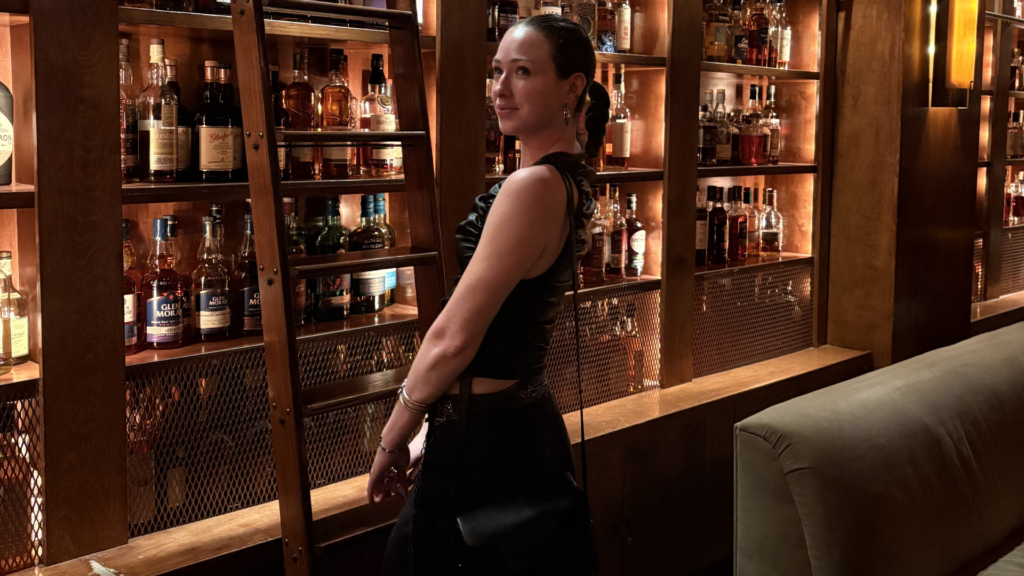
Still, some of the most memorable nights come from places that do not fit neatly into any itinerary. When asked for a spot people might not expect, Emma points to Macao Trading Company in Tribeca, a longtime staple that continues to defy the city’s tendency to segment itself. “You will find people of all ages in here, literally all ages,” she says. “Like 24 to 65, 70-ish just letting loose and paying no mind.” It is less about the scene and more about the energy, a reminder that the best nights often happen when expectations fall away.
That openness is also what defines how she navigates the overlap between nightlife and her career. “It’s 1000% an extension of my work,” she says, though not in the way one might expect. “I think that I’m only finding opportunities while out and about because I’m not going out with the intention of procuring business.” In a city where networking can feel transactional, her approach is almost counterintuitive. “People can read genuineness like the back of their hand,” she adds, and it is precisely that lack of agenda that makes the connections real.
Those connections, more often than not, turn into something tangible. “Yes, almost every time I go out,” she says when asked if she has met clients or opportunities through nightlife. “It’s like magic and there’s nothing like it.” The follow-through is just as important. “Always follow people on Instagram,” she says. “People always see what I post about my personal and professional life and come to me with opportunities.”
In many ways, her approach reflects a broader shift in how people think about both work and social life in their late 20s. The separation between the two becomes less rigid, replaced by a more integrated version of identity. “Going out and socializing is a part of my identity as a person,” she says. “And as a real estate agent, the most effective way to build a brand is to seamlessly merge your personal and professional brand.”

Even her perspective on dating reflects this evolution. “I’m 99% more likely to see someone I’m interested in at the gym at 5:30 am rather than out at 10:30 pm,” she says, offering a dose of realism that cuts through the mythology of late-night encounters. Still, she points to a more strategic window. “The easiest way to meet a serious prospect is at a restaurant bar on a Thursday before 8:30 pm.”
If there is one idea she dismisses entirely, it is the notion of aging out of nightlife. “Is that even a thing in New York?” she says. The answer feels obvious. This is a city that does not operate on timelines in the traditional sense, where every phase of life comes with its own version of momentum. “The real fun is just getting started,” she adds.
And that is ultimately what defines this era. Not a winding down, but a leveling up. Better instincts, better boundaries, better nights. Somewhere between closings and cocktails, between structure and spontaneity, is where New York starts to make the most sense.