Exclusive
How Singer, Chanez, Found her Rhythm in Los Angeles
Chanez opens up about writing her single “Los Angeles,” working with Rupert Wainwright, and building her music career in Los Angeles through discipline and artistic integrity.
- By: Julianne Elise Beffa
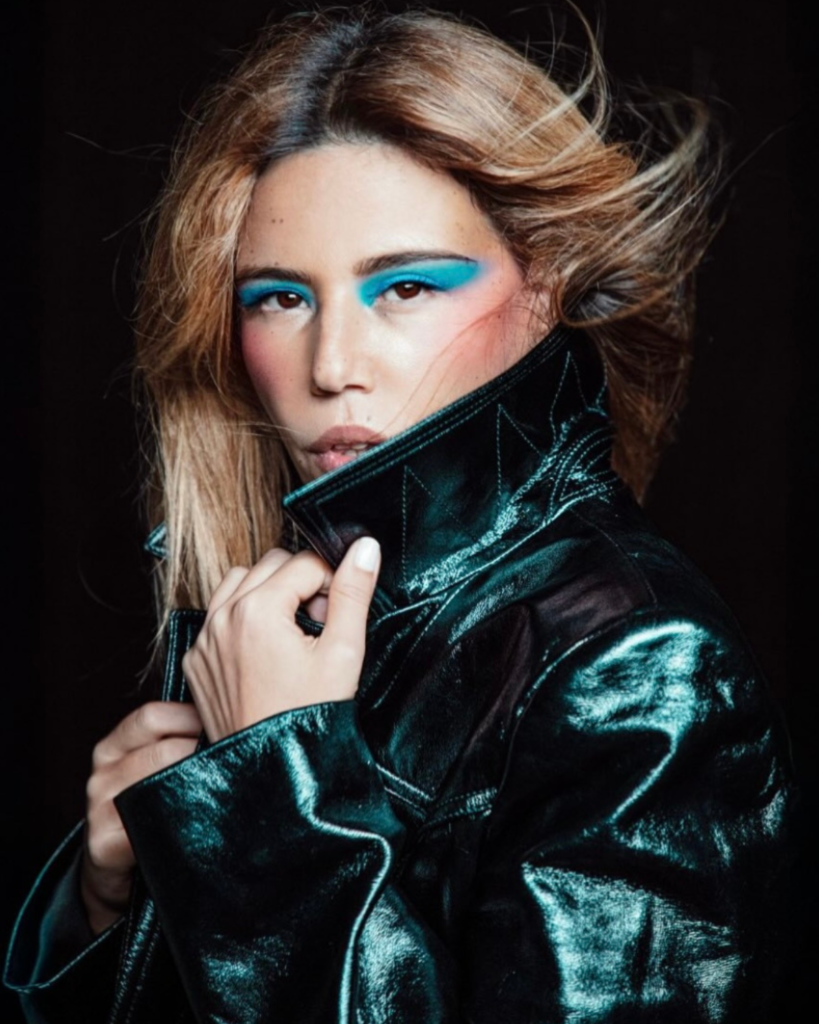
On a warm Los Angeles evening, when the sky softens into gold and the city feels suspended between ambition and possibility, Chanez speaks about reinvention with the calm clarity of someone who has lived it. Now based in Los Angeles, the singer and songwriter has released her latest single, Los Angeles, a deeply personal record that captures her evolution as an artist while firmly establishing her authorship and creative authority in the Los Angeles music scene. The track is not just another release. It is a statement of identity, resilience, and intention from a self-written artist building her career on discipline rather than spectacle.
“When I was 20, I studied cinema at UCLA, focusing on acting and directing. Even then, I knew I wanted to come back to Los Angeles one day,” she told LOOP Mag in an exclusive interview, “but because of my career, not by chance.”
That vision became a life goal. The song captures the journey between that ambitious student with big dreams and the woman who eventually returned stronger, having earned her place through her own work. For Chanez, Los Angeles is not just a city. “Los Angeles represents a promise I made a long time ago- not only to myself, but to my parents,” she says. “Coming back wasn’t just a professional milestone, it felt like honoring that promise.”
The emotional core of the record runs deeper than geography. After losing her parents, grief reshaped her relationship with strength. “Grief can either freeze you or forge you,” she explains. “For me, it became fuel.” Transforming wounds into foundations was not dramatic or theatrical. “In real life, rebuilding wasn’t dramatic. It was quiet and disciplined. It meant choosing not to collapse when it would have been easier to, working when no one was watching, believing when there was no applause, and staying consistent through doubt.” That quiet discipline is embedded in every lyric of “Los Angeles,” a track that moves between introspective French verses and an uplifting English hook. The bilingual structure mirrors her identity. “French is the language of my inner world- it carries nuance, emotion, and depth. English, especially here in Los Angeles, carries openness, light, and universality. The French verses hold the intimacy of the story, while the English hook expands it outward.”
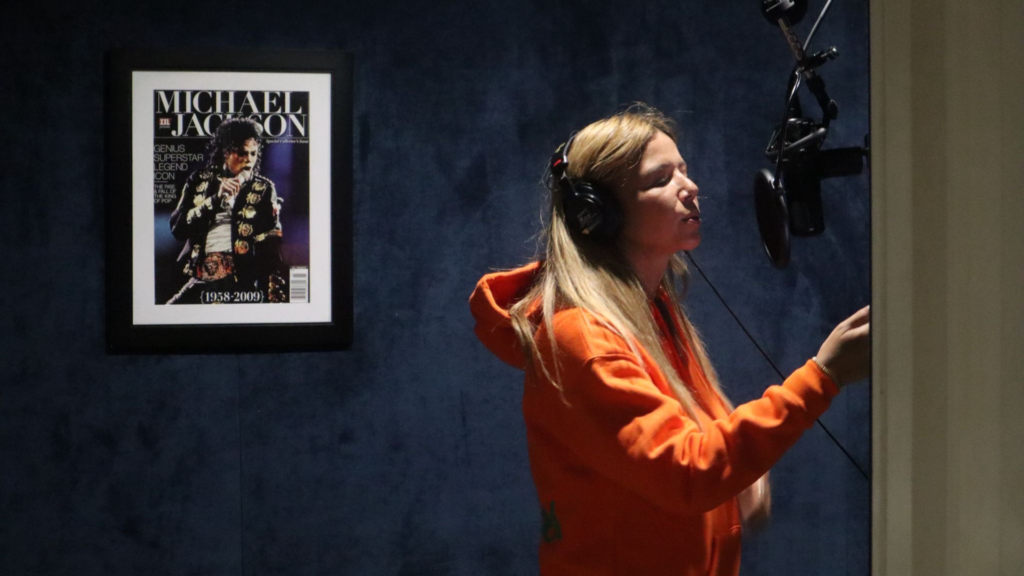
The urgency behind the song was rooted in authorship. “I needed to claim full ownership of my story,” she says firmly. “What felt urgent and non-negotiable was reclaiming that narrative.” Since the beginning of her career, Chanez has made a deliberate decision to write all of her songs herself. “I’ve been approached by some of the most respected international songwriters, which I deeply appreciate, but I’ve always chosen to remain the sole author of my work. For me, artistic integrity and authorship are part of the foundation- not an option, but a principle.” In an era where writing camps and collaborative credits dominate the industry, her commitment to sole authorship reinforces her credibility as a true singer-songwriter. “Los Angeles isn’t about celebrating success in a superficial way,” she continues. “It’s about honoring the cost of it: the silence, the isolation, the betrayals, the years of persistence. In a city like Los Angeles, where image can sometimes speak louder than truth, it was important for me to speak mine clearly.”
The sonic world of the record was shaped by Sami Beats, a young beatmaker she met in Los Angeles almost by accident. “Meeting Sami Beats in Los Angeles was almost accidental- he was there on vacation when we connected,” she recalls. “There was something very organic about it.” Working with him brought a new dimension to the track. “He has an instinct for atmosphere- he understands how to leave space, how to let emotion breathe. That sensitivity was essential for ‘Los Angeles,’ because the production needed to feel cinematic but intimate at the same time.” She pauses before adding, “What struck me most is that he’s not just a beatmaker, he’s a complete artist. Extremely talented, highly professional, and deeply intuitive.” The result is a production that supports rather than overwhelms, allowing her lyrics and emotional arc to remain central.
'Los Angeles' isn’t about celebrating success in a superficial way, It’s about honoring the cost of it: the silence, the isolation, the betrayals, the years of persistence.
Visually, the project reached another level through her collaboration with Rupert Wainwright, the acclaimed British director behind Stigmata starring Patricia Arquette, iconic music videos for Michael Jackson, and the GRAMMY Award-winning long-form project Please Hammer Don’t Hurt ’Em: The Movie. “I met Rupert while we were discussing a different project,” she says. “At the same time, I was developing ‘Los Angeles’ and imagining a very simple visual- a woman walking through the city.”
Instead, Wainwright proposed a studio concept with immersive moving visuals inspired by timeless minimalism. “To my surprise, he immediately connected with the project,” she says. “It was truly an honor to collaborate with a director of his caliber at this stage of my career.” The experience sharpened her instincts. “Honestly, what I learned most is that I can work much faster than I thought. It reinforced my ability to trust my instincts and move quickly when needed.” The visual did not change the meaning of the song, but it clarified it. “It confirmed that ‘Los Angeles’ is about presence, not spectacle.”

Living in Los Angeles has reshaped her creatively in ways that extend beyond the studio. “The city moves with ambition and reinvention, and that energy pushes you to think bigger,” she explains. “Creatively, I feel sharper, more international, and more intentional about every choice I make. Los Angeles doesn’t just inspire you- it demands clarity.”
That clarity extends to how she navigates the city’s cultural scene. She finds inspiration at Chateau Marmont, drawn to its dim light and layered conversations. “There’s something timeless about it — the atmosphere inspires me deeply,” she says. On Tuesday nights, she gravitates toward Casablanca Karaoke at Andy’s, hosted by Judah Johnson. “It’s one of those rare spaces where emerging artists and more established ones share the same stage. There’s no filter — just presence, risk, and performance.” Still, she remains grounded. “I usually limit myself to one night a week, because my work requires discipline and focus. Nightlife inspires me, but the real work happens in private — writing, refining, studying, building.”
For Chanez, there is no divide between the woman seen in cultural spaces and the artist heard through speakers. “There has never been a divide between who I am in public and who I am in my music. I reveal myself entirely in my work — without calculation, without disguise.” Everything about her trajectory, she insists, is intentional. “Nothing about me is accidental. What people see publicly is supported by years of resilience and work. It is the same woman — expressed in different dimensions.” In a city known for illusion, Chanez has chosen authorship, clarity, and endurance. With “Los Angeles,” she is not just singing about rebirth. She is living it, line by line, in the heart of the Los Angeles music industry.
Read More



Nightlife + Dining
Amanda Coscarelli